
WSV Youth Soccer Perspectives
From Better Clubs to Better Youth Soccer Architecture
The 2017 club proposal and WSV's framework for youth soccer
WSV's 2017 presentation proposed a better club: invest in coaches, redirect spending, observe players over time, communicate clearly and use competition intentionally. This report examines that documented proposal and develops WSV's framework for youth soccer. It is an interpretive analysis, not a representative survey or an evaluation of the model's outcomes.
Earlier perspective: Parental Perspectives on Youth Soccer
From the institution to its functions
The proposed club model expected one institution to deliver competition, development, selection, evaluation, communication and access to future opportunities. The same organization selling the service would continue to judge the quality of its own work and control the decisions that followed.
Better rules can improve a club, but they cannot resolve every conflict created when several distinct functions are collapsed inside one institution. The report therefore begins with the player: what function does the player need, who is responsible for delivering it, what evidence demonstrates that it worked, and how will the next decision be made?
The five-function map
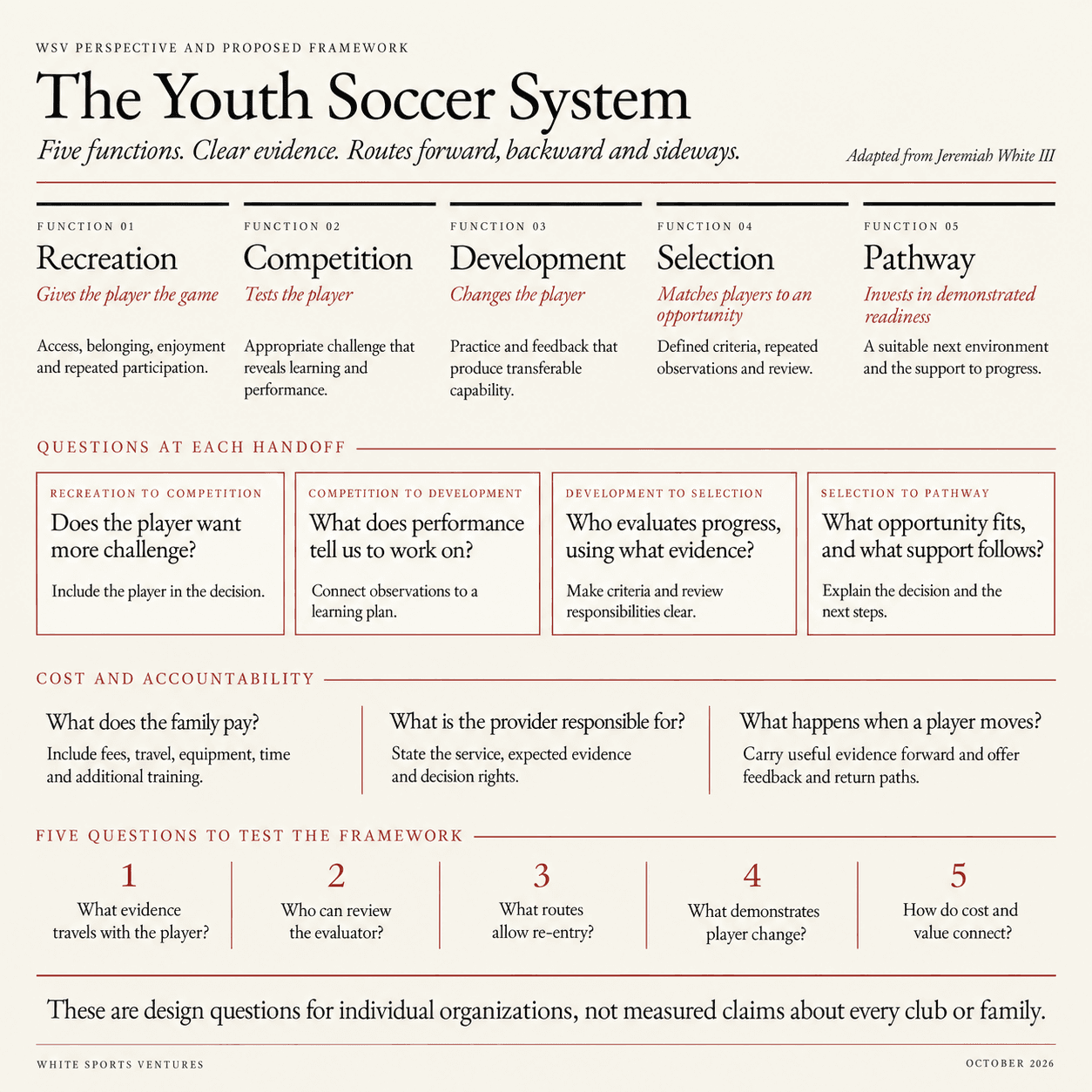
- Recreation gives a player the game. It creates access, familiarity, belonging and repeated contact with soccer.
- Competition tests the player. Its value comes from the quality of the test, not simply the result.
- Development changes the player. More sessions, touches or private lessons become development when the player gains a capability that transfers into play.
- Selection sorts players for a defined purpose. A decision should identify its purpose, criteria, evidence, decision-maker and time horizon.
- Pathway invests opportunity and resources in demonstrated readiness. It connects a player with an appropriate next environment and the support that environment will provide.
These are functions, not a compulsory ladder. One organization can perform several of them. Players can move forward, backward or sideways based on need, with feedback and opportunities for re-entry.
What should travel with the player
Each handoff needs a basic contract: purpose, evidence, decision rights, communication and a return path. Competition should send information back to development. Selection should reveal which capabilities the development environment is producing or missing. A pathway decision should identify the next opportunity or explain the gaps that call for another period of development.
Evidence should be proportional to the consequence of the decision. A local recreational placement requires little assessment. A high-cost pathway decision requires more observations, more context and a clearer explanation.
The parent, the player and the provider
The parent purchases the service; the player receives it. Their experiences answer different questions. Parent feedback can establish whether communication was clear, commitments were kept and the environment was reliable. The player's voice and repeated observations are needed to understand learning, motivation, belonging and developmental change.
The organization delivering a service can contribute evidence, but consequential decisions should not rely solely on its self-assessment. Shared criteria, independent observation and review can help clarify the relationship between teaching, evaluating and allocating opportunities.
Research scope and limitations
The submitted report places the historical work in Philadelphia and South Jersey. The directly reviewable 2017 presentation documents discussion prompts and a proposed club model. It does not provide participant responses, direct player evidence or an operational evaluation. This edition therefore omits unverified participant counts, percentages, quotations and coding claims.
The five-function map is WSV's subsequent framework for diagnosis and design. Its research agenda calls for broader participation, separate player and parent evidence, longitudinal observation, and measurement of what happens when players move between environments.
Historical supporting material
Exploring Youth Soccer Development Models — October 8, 2017 presentation (PDF)
This presentation contains the discussion prompts and proposed club model, including the original spending reallocation and assessment schedule. Its costs are historical design assumptions, not current market benchmarks. The internal focus-group record and later synthesis referenced in the submitted report were not available for this edition and are not used to verify participant findings.
Training frequency, touches, games and travel are inputs. The organization should define the change or evidence it expects before increasing activity.
Selection should specify the opportunity, criteria, evidence, decision-maker and review period.
Player feedback should be age-appropriate and separated from parent satisfaction.
Players need development plans, re-evaluation windows and legitimate alternative routes.
The Youth Soccer System
WSV's working framework, adapted from Jeremiah White III and revised October 2026. These are design questions for individual organizations, not measured claims about every club or family.
Common questions about this report
How does this report relate to the earlier parental-perspectives research?
This report examines the club proposal documented in WSV's 2017 presentation and develops a framework that distinguishes recreation, competition, development, selection and pathway. The earlier parental-perspectives report remains available as an archived synthesis with an editorial correction explaining its evidence limitations.
Does the framework require five separate organizations?
No. One organization can perform several functions, and different organizations can perform the same function. The report asks each provider to clarify its purpose, the evidence it produces and who makes consequential decisions. Complete institutional separation is not always practical; role clarity and review are still possible.
Was the proposed club model tested?
The available material documents a proposed design. It does not establish an operational test of outcomes, economics or scalability. This report examines architectural limitations and tradeoffs without claiming that the model was implemented and failed.
What can the 2017 research establish?
The 2017 presentation documents discussion prompts, proposed operating rules and illustrative costs. It does not supply a participant response dataset or establish research methods, population prevalence or measured outcomes. This edition omits unverified participant statistics and quotations and identifies WSV's framework as interpretation and recommendations.
Get the Full Report
Download the complete 16-page analysis with detailed frameworks, data tables, and actionable recommendations.
Copy formatted citation for academic or professional use
White Sports Ventures. (2026, October 1). From Better Clubs to Better Youth Soccer Architecture: The 2017 club proposal and WSV's framework for youth soccer. https://www.whitesportsventures.com/reports/youth-soccer-architecture